Photography: A Neutral Medium?
Since its emergence in the 19th century, photography has illustrated how invisible privileges can become embedded even in a medium we tend to perceive as neutral.
Early photographic processes were developed and refined using lighter skin tones as a reference, making the nuances and details of darker skin more difficult to capture accurately. This bias persisted into colour photography: Kodak films also struggled to reproduce Black skin tones faithfully. In the 1970s, it took complaints from furniture and chocolate manufacturers, whose products suffered from poor reproduction of brown tones, for this technical limitation to receive greater attention. An almost literal illustration of invisible privilege: when you conform to the norm, you can remain unaware that the norm even exists.
But photography did not merely reproduce these biases through its technology. It also embedded them in our collective imagination through one of its most fundamental practices: portraiture. The history of portraiture is also the history of those who were photographed, those who were portrayed differently, and those who remained outside the frame. Depending on their social class, gender, sexual orientation, disability, or conformity to the norms of their time, not everyone had equal access to a representation of themselves that they could choose and feel valued by. Some were photographed to affirm their status and leave a record of their existence; others had to conceal part of their identity or were portrayed through a medical, police, scientific, or sensationalising gaze.
To be unrepresented is not simply to remain unseen: it is also to be excluded from the collective narrative. As photography became a form of society's collective memory, those it depicted came to embody that society in the public imagination. To have a place in the image is also to have a place in the story a society tells about itself.
Portraiture has also played a decisive role in shaping our standards of beauty. It did not simply record the appearances of an era: it helped define and disseminate what was considered beautiful, youthful, respectable, or desirable. Posing, lighting, framing, clothing, settings, and later retouching all contributed to establishing certain faces and bodies as ideals.
Because photography appears to simply record what stands before the lens, its power is particularly significant: it can make what is, in fact, a social construct appear natural.
It is this history that guided my choice of the wet-plate collodion process for Invisible Privileges. Returning to one of the techniques that accompanied the early days of photography means revisiting the period when many of the conventions of representation we still inherit today first took shape. Nearly two centuries later, in the age of artificial intelligence, some of these biases persist and are reproduced in new forms. Technologies evolve, yet they continue to reflect the social norms that shape them, influencing what we see, what we value, but also what we fail to see.
1. Protocole
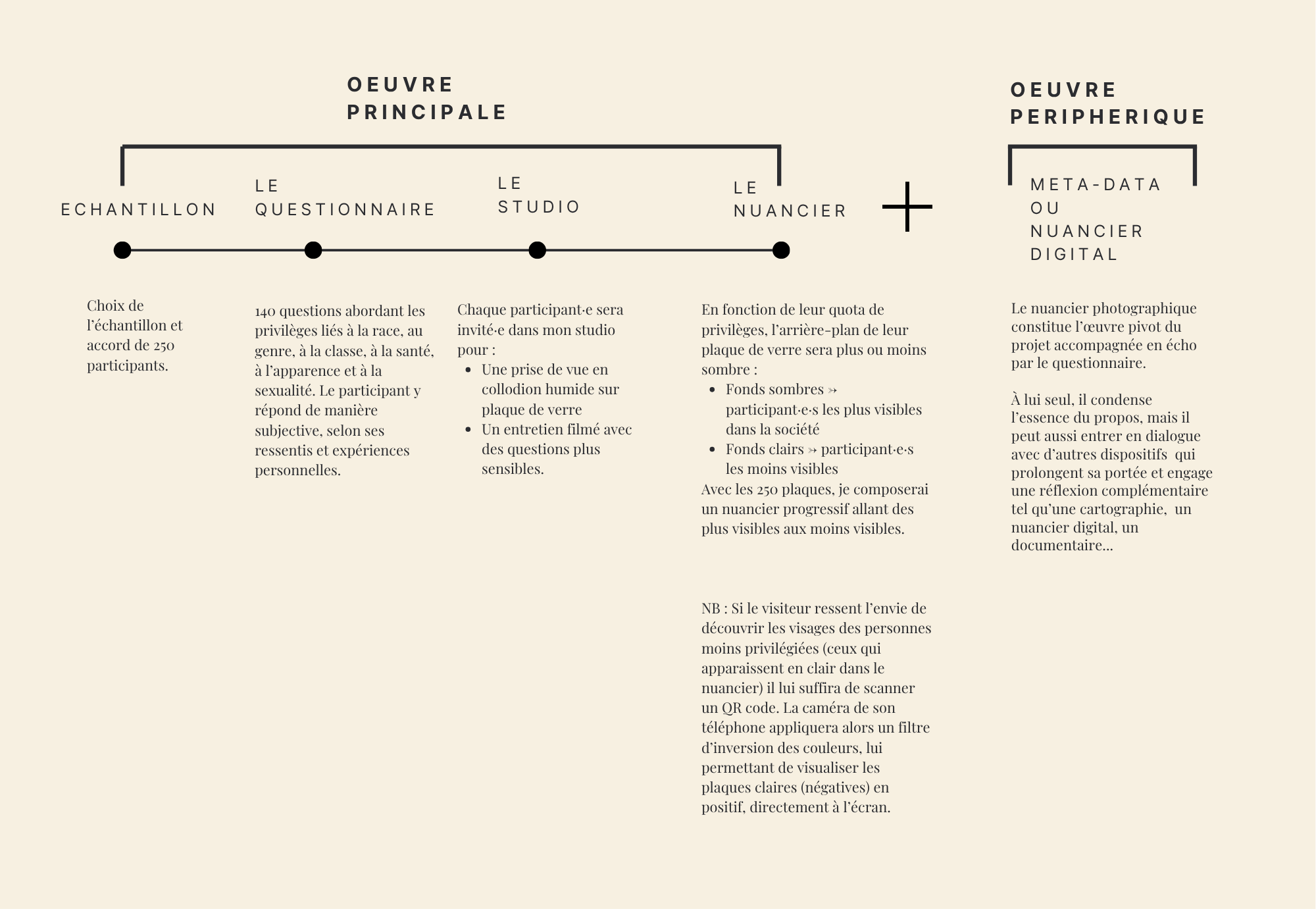
- SAMPLE SELECTION: Detailed explanation in Appendix 2.B.
- DISCRIMINATION CATEGORIES: Detailed explanation in Appendix 2.C.
2. Scenography
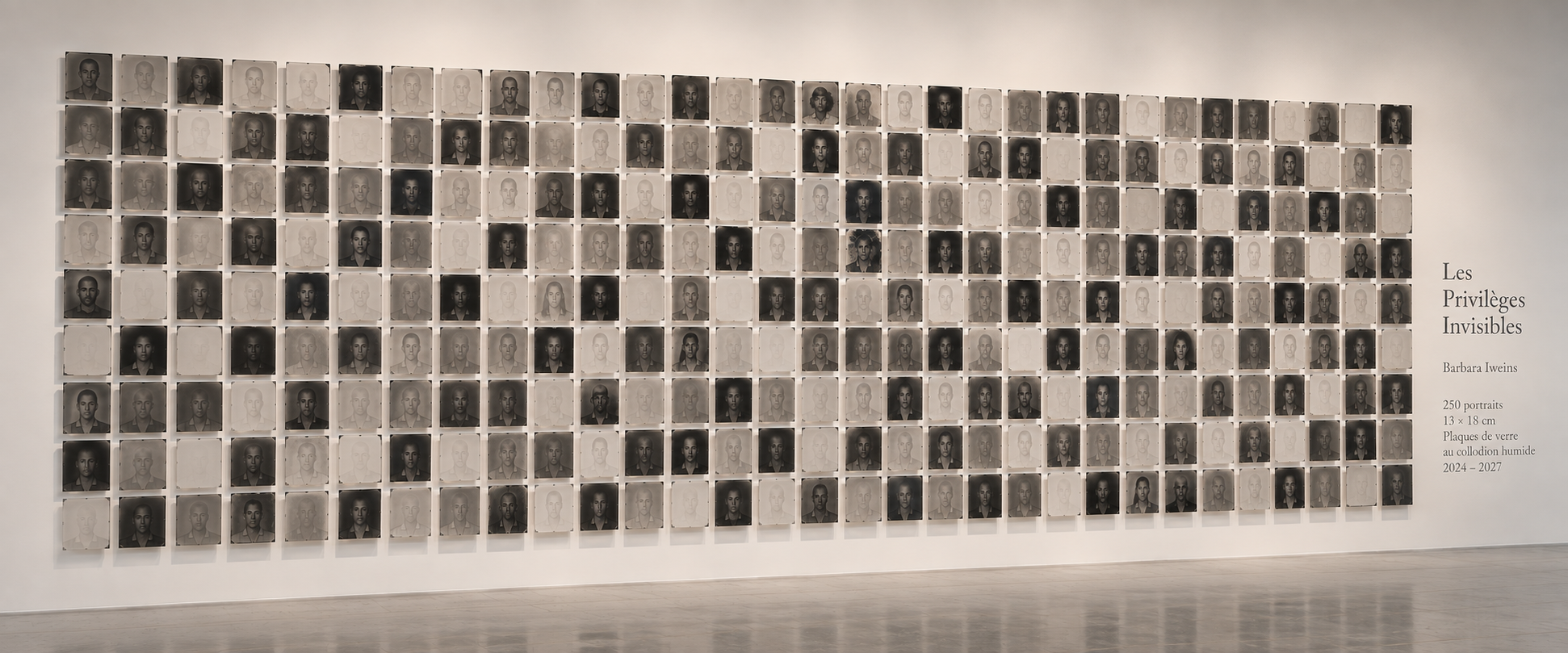
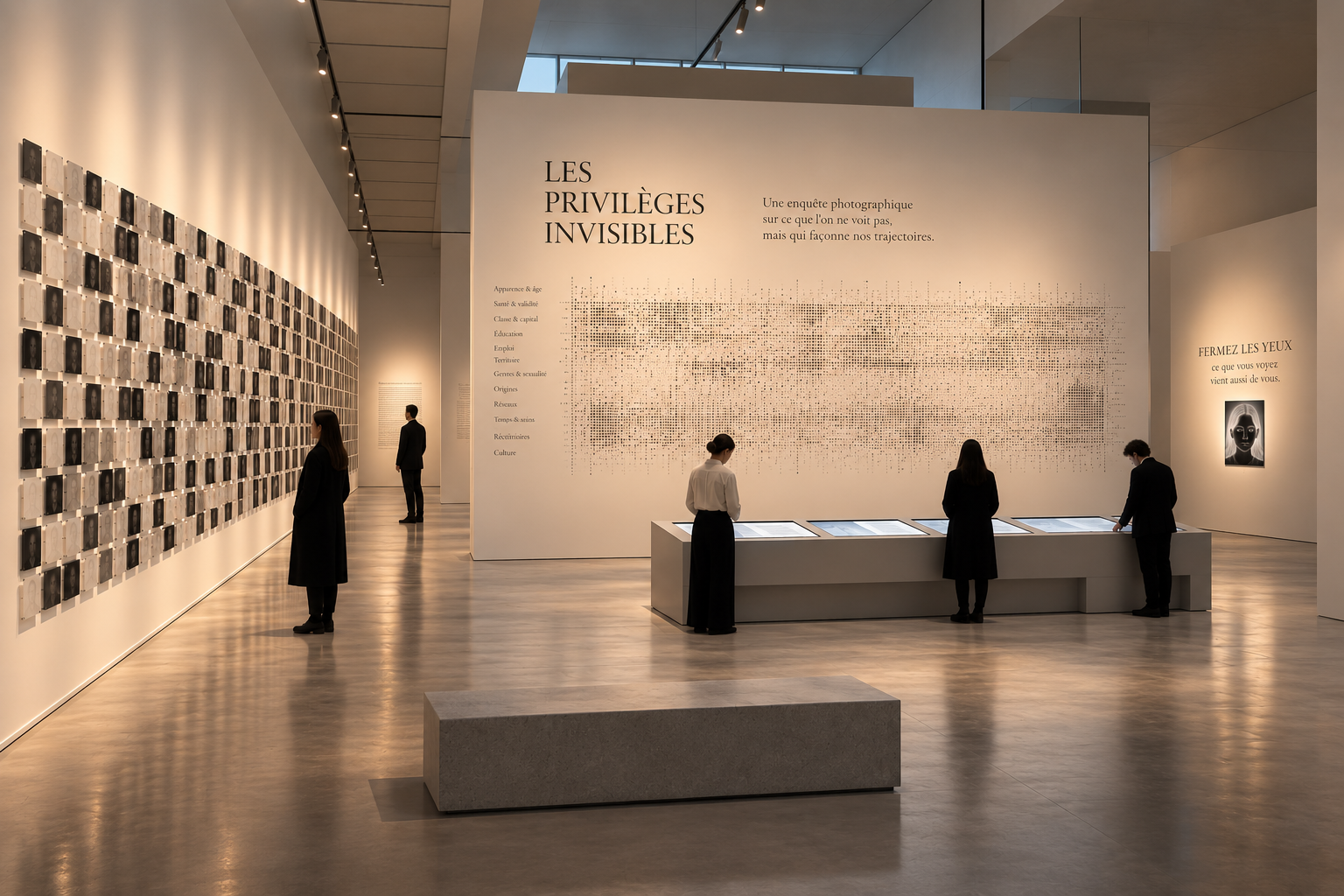
The central work of Invisible Privileges is a photographic patchwork composed of 250 ambrotypes (wet-plate collodion glass photographs), each measuring 13 × 18 cm, mounted slightly away from the wall, as if suspended in mid-air. Each portrait is associated with a privilege score, calculated from a 140-question survey exploring experiences of discrimination and perceived advantages.
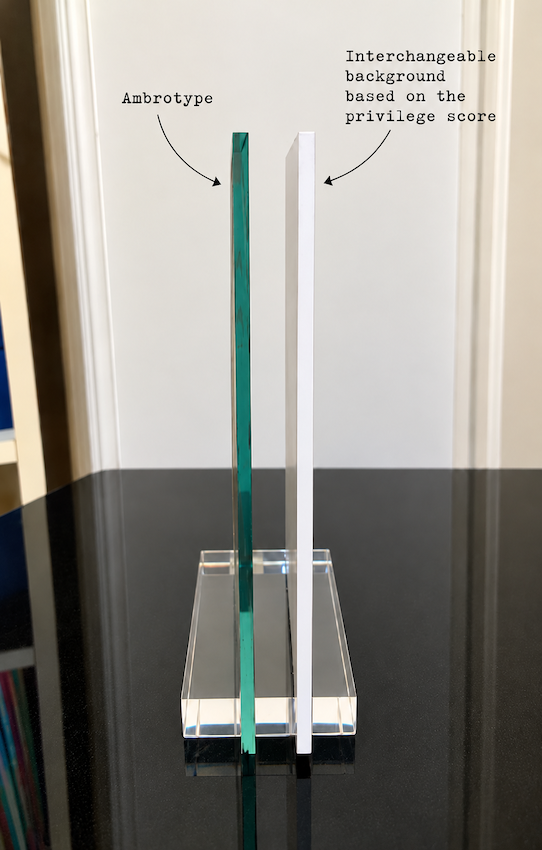
Each portrait consists of two separate plates, positioned one centimetre apart: at the front, the ambrotype on transparent glass; behind it, a second plate whose colour varies according to the privilege score. The higher the score, the darker the background, bringing the face into sharp relief. Conversely, the lower the score, the lighter the background becomes, fading towards white, where the portrait is rendered almost invisible. Together, the portraits form a spectrum ranging from white to black, through every shade of grey (see exhibition design above).
This artistic choice makes a central tension visible: some lives command attention in the public sphere, while others fade from view. The installation reveals the subtle architecture of the positions we occupy without ever having chosen them.
If visitors wish to discover the faces of the less privileged individuals in the patchwork (those appearing in the lighter shades of the spectrum), they can simply scan a QR code. Their phone’s camera will then apply a colour-inversion filter, allowing them to see the lighter plates (negatives) as positive images, directly on their screen.
I see numbers as an essential tool for deconstruction: they allow us to challenge our perceptions and reveal mechanisms that may remain imperceptible at an individual level.
The 140 questions asked of 250 participants transform individual experiences into comparable data, revealing deeply personal statistics: exposure to sexism, racism, ableism, classism, or lookism, as well as the accumulation or absence of certain social advantages.
At the same time, these data become a tool for sociological self-analysis. The 250 participants form a statistical imprint of my own social environment: not a representative sample of society, but a map of the world I have actually been exposed to.
By placing these relationships along the timeline of my life, it becomes possible to observe what was socially visible to me at different stages, what remained invisible, and how social insularity and homophily have gradually shaped my frame of reference.
As in Katalog, juxtaposing this intimate data with broader statistics allows an individual story to enter into dialogue with the social structures that shape it. Because the world around us also helps define what we consider “normal” — and perhaps what we are, or are not, able to recognize as a privilege.
CLICK ON THE VISUAL TO EXPLORE THE INTERACTIVE DATA (PROTOTYPE)
This prototype presents the initial stages of research and experimentation for the interactive installation. Its final visual form has yet to be developed.
The data shown is fictional.
In collaboration with Karim Douëb. 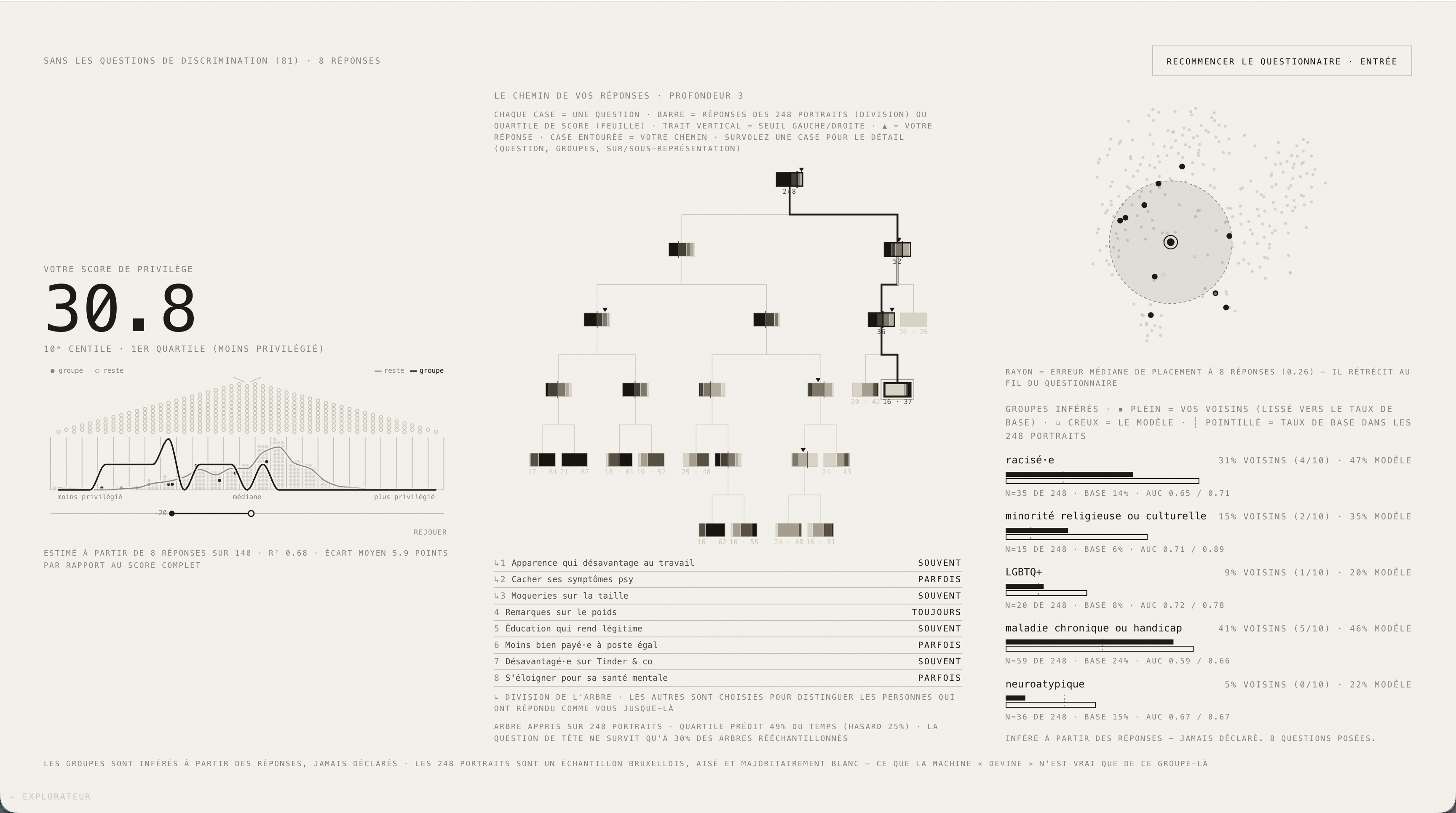
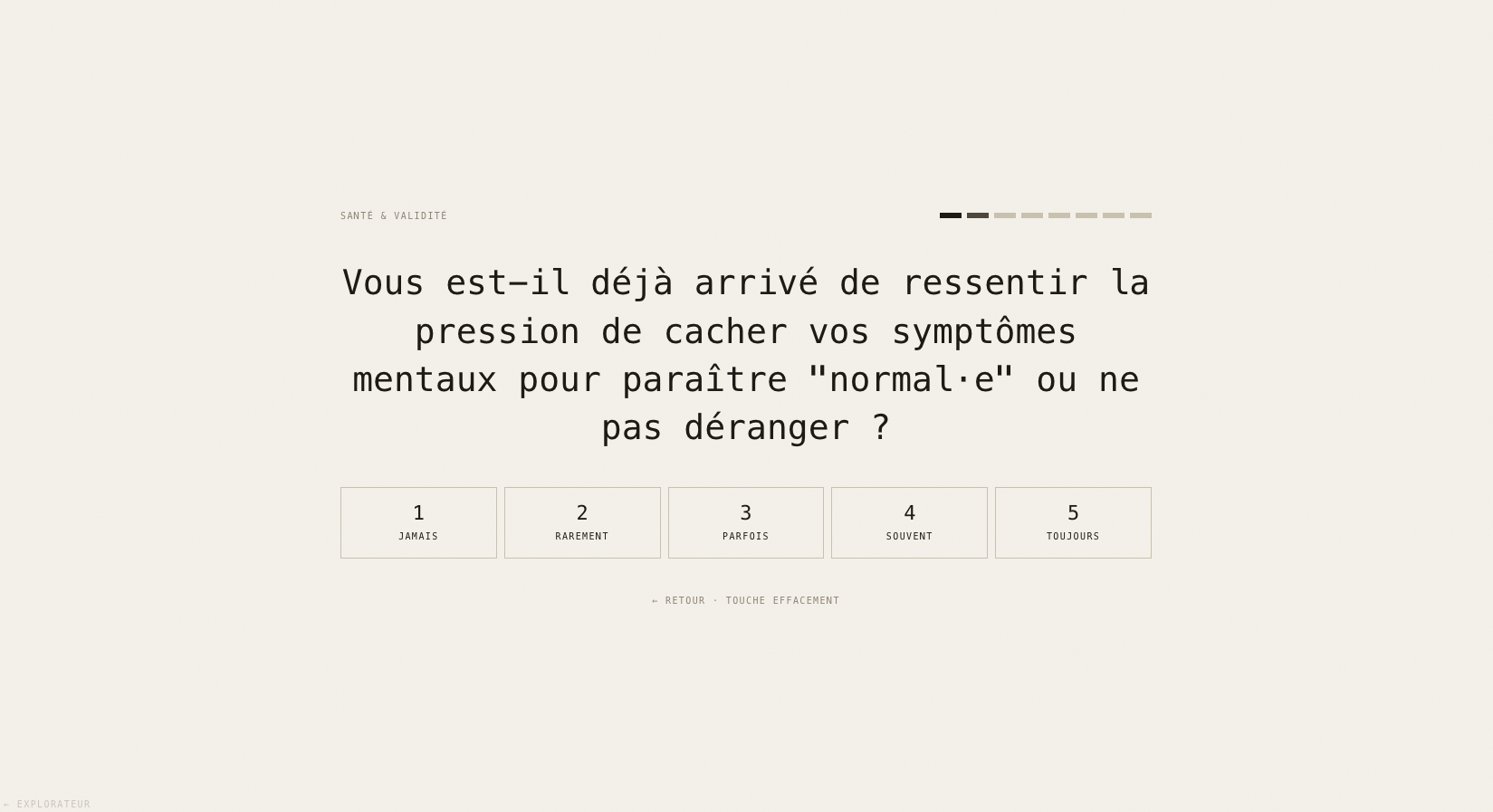
Within the exhibition, each visitor is invited to complete a shorter version of the same questionnaire on a computer. A program will then generate their portrait, which, depending on their privilege score, will be either fully visible or partially obscured. Taking part in this exercise is already a first step towards deconstructing one's own privileges.
CLICK ON THE VISUAL TO EXPLORE THE INTERACTIVE DATA (PROTOTYPE)
This optical illusion illustrates the unconscious biases at work when we encounter someone. We never begin with a blank slate. Our gaze is already shaped by associations, representations, and prejudices inherited from our personal, family, social, and collective histories.
In a matter of moments, sometimes before we are even aware of it, we interpret a multitude of cues (skin colour, perceived gender, age, appearance, clothing) through representations and biases already embedded within us. Social categorization, implicit stereotypes, and the halo effect are just a few manifestations of this process.
The afterimage makes this invisible dimension of perception tangible: what we see in others is also shaped by what we already carry within ourselves.
3. Photo Book
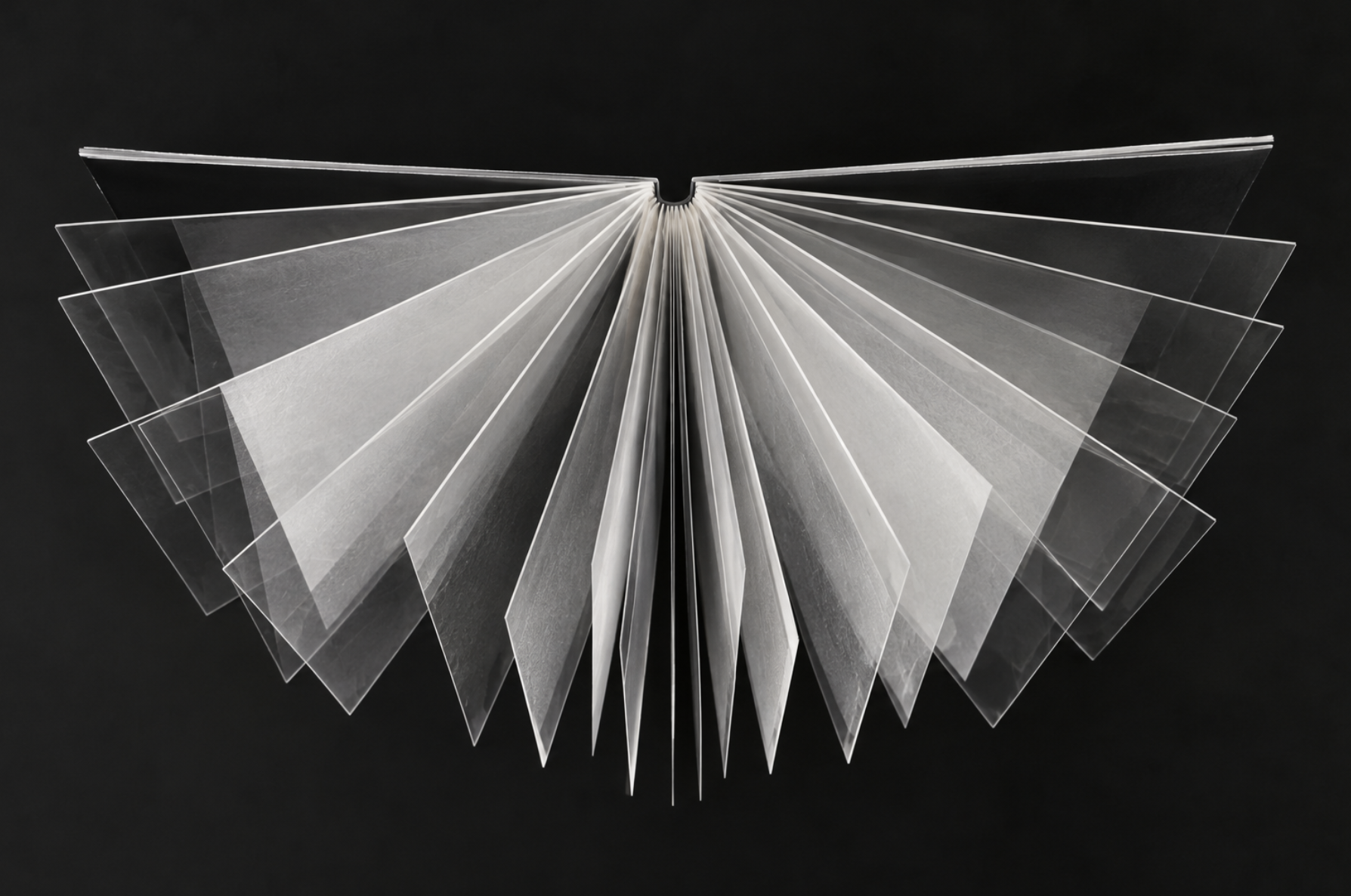
Alongside the exhibition, I would like to develop the idea of an entirely transparent photobook. The text and images would only become visible as the pages are turned, through the insertion of three sheets of card in different shades: black, dark grey and light grey.
In the spirit of Katalog, I want to undertake a form of self-sociological inquiry, this time turning the lens on my own life, with as much honesty as possible.
Somewhere between a photobook and a sociological essay, it would bring together portraits, personal accounts and interviews with people in my social circle, statistical analysis and an examination of deeply rooted prejudices. Through these conversations, I would seek to explore their life stories, their contradictions and the things they may not always recognize in themselves. An investigation conducted with as much honesty as possible, starting with myself.
We often participate in the very systems we sincerely condemn. We can identify as feminists while reproducing sexist attitudes, or defend equality while perpetuating prejudice. Responsibility does not necessarily begin with the intention to discriminate. It also lies in what we perpetuate without even realizing it.
I am certainly no exception to these contradictions.
I read Despentes, Ernaux and de Beauvoir, loudly proclaimed my feminism, while telling anyone who would listen that, had I been a man, I would probably have been terribly misogynistic. Raised with a universalist belief that we were all fundamentally the same, I spent years defending certain St. Nicholas traditions without recognizing what they might perpetuate, even though people of colour were almost entirely absent from my social circle.
For a long time, I also attributed my ability to get out of certain situations so easily to my sense of humour. It took perimenopause, and the gradual decline in the attention I received, for me to realize that my physical appearance may have had far more to do with it than I had imagined.
All these contradictions between the values I believed I stood for and what I was unknowingly helping to perpetuate.
The purpose of this book would be to explore these blind spots, without seeking either to excuse or condemn myself. To understand how our privileges shape not only our opportunities, but also our beliefs, our behaviour and even the way we see ourselves.